

Why Your Factory Forgets
Lede
In a fluorescent-lit corridor of a tier-one automotive supplier outside Ulsan, a 27-year veteran maintenance technician named Kim retired on a Friday in March. The following Monday, a CNC spindle on Line 3 began producing parts 18 microns out of tolerance. The line supervisor pulled the maintenance log. The log said the spindle had been recalibrated in November. It did not say that Kim recalibrated it differently than the manual specified — a deliberate compensation for a known harmonic resonance from the adjacent press, a resonance that only manifested when ambient temperature exceeded 24°C. Kim had been making this adjustment, undocumented, for nine years. The line ran for six days at 73% yield before someone called him at home.
This is not a story about poor documentation. The plant was ISO 9001 certified. The maintenance management system was SAP. Standard work was posted in three languages. The story is about the gap between what a facility records and what a facility knows — and the fact that this gap is not an accident of bad process. It is structural. Manufacturing facilities lose operational knowledge every time a worker leaves, a machine moves, or a layout changes — digital twins are the fix. This series will argue, across twelve episodes, that the digital twin’s primary value is not visualization. It is memory.
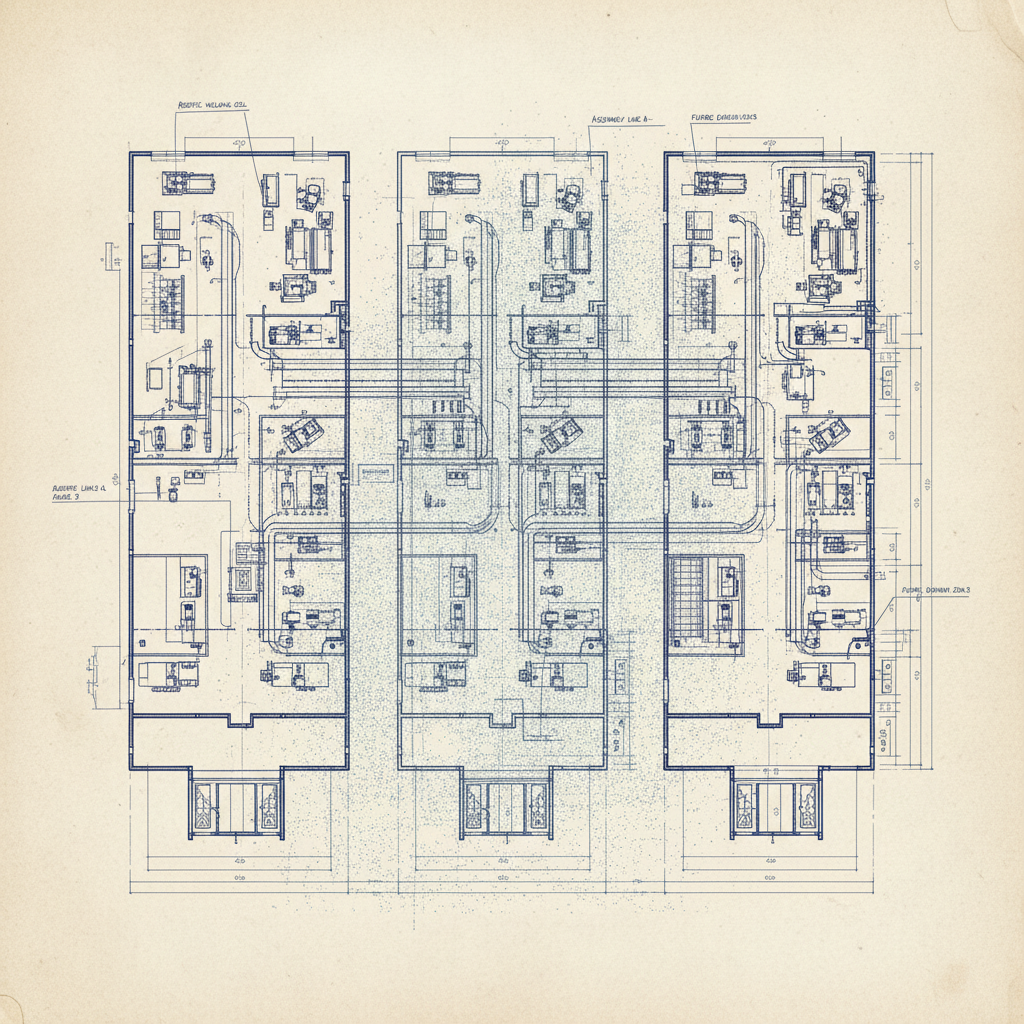

Context
The manufacturing sector in advanced economies is staring at a demographic cliff that the industry has discussed in the abstract for two decades and is now experiencing as operational reality. The U.S. Bureau of Labor Statistics projects 3.8 million manufacturing job openings in the U.S. through 2033, with roughly half going unfilled. In Korea, the average age of a skilled manufacturing worker has crossed 43, and the country’s working-age population is contracting at a pace OECD analysts now describe as without modern precedent. Germany’s Mittelstand reports similar curves. Japan crossed this threshold a decade ago and has been improvising ever since.
The conventional response is automation. Replace the retiring worker with a robot, the retiring inspector with a vision system, the retiring planner with an APS module. This response is correct as far as it goes, but it misunderstands what is actually being lost. What retires with Kim is not a pair of hands. It is a model — an internal, unwritten, embodied model of how a specific physical space behaves under specific conditions. This model includes the harmonic from Line 3’s press, the way humidity in monsoon season warps the rear loading dock door, the precise sequence in which the three air compressors should be cycled to avoid a 4 a.m. pressure drop, and roughly 8,000 other facts that nobody ever asked Kim to write down because nobody knew he knew them.
This is tacit knowledge in Michael Polanyi’s original sense: knowledge that exceeds the knower’s ability to articulate it. ERP systems do not capture it. MES systems do not capture it. Standard operating procedures capture, at best, the version of it that was true on the day the SOP was written. And every layout change, every line rebalance, every equipment swap silently invalidates portions of the institutional memory that nobody has audited because nobody has indexed.
Argument
The thesis of this series is that a digital twin, properly constructed, functions as the operational memory of a physical space — and that this framing, not the more common framings of “3D visualization” or “simulation environment,” is what makes the technology economically defensible.
Consider the four mechanisms by which a factory forgets.
The first is **personnel turnover**. When Kim leaves, his model leaves with him. No exit interview recovers it because Kim himself cannot enumerate it. He recalibrated the spindle by feel. The feel is not transferrable through language.
The second is **physical reconfiguration**. A line rebalance moves twelve workstations three meters east. The cable trays are rerouted. The ventilation pattern shifts. The new layout looks identical to the old layout in the CAD file because the CAD file was never updated, or was updated to reflect intent rather than as-built reality. Six months later, an engineer trying to debug a quality drift consults a drawing that describes a factory that no longer exists.
The third is **equipment substitution**. A pump is replaced with a “functionally equivalent” unit from a different manufacturer. The replacement is documented in the asset registry. What is not documented is the fact that the new pump has a different vibration signature, draws 4% more current under load, and couples differently to the structural floor. Three quarters later, when bearing failures begin appearing on a downstream conveyor, no one connects the failures to the pump swap because the pump swap is not, in any retrievable system, connected to the conveyor.
The fourth is **environmental drift**. The building itself changes. Roof insulation degrades. A new tenant moves into the adjacent unit and runs a noisy chiller. A nearby road is widened and increases vibration through the slab. None of this is captured in any system because none of it falls within any individual department’s scope of responsibility.
Against these four mechanisms, the conventional document-based knowledge management approach is structurally inadequate. Documents capture intent at a moment in time. They do not capture the spatial, temporal, and causal relationships that define how a facility actually behaves. A digital twin can — but only if it is built as a memory system rather than as a visualization. This means three things: it must be geometrically accurate to the as-built state, not the as-designed state; it must be tagged with semantic and behavioral metadata, not just polygons; and it must be updated as the physical space changes, with the changes themselves recorded as a temporal layer.
A 3D model that fails any of these three tests is not operational memory. It is a screensaver.
Case Study: Boeing’s 777X Digital Twin Program
Boeing’s experience with the 777X program is the most instructive public case study of digital twin economics in heavy manufacturing. Boeing began building digital twin infrastructure for the 777X in earnest in the mid-2010s, integrating model-based engineering across design, tooling, and assembly at the Everett, Washington facility. Then-CEO Dennis Muilenburg publicly stated in 2018 that the digital twin approach was projected to deliver up to 40% improvements in first-time quality for engineering-intensive parts.
The 777X program has since become a more complicated story — flight test pauses, certification delays, charges against the program — and it would be inaccurate to attribute these difficulties to the digital twin itself. What the program did demonstrate, however, is the specific operational mechanism by which digital twins create value at scale: when a tooling change on the composite wing was required mid-program, engineers could trace the downstream implications across thousands of mating parts, fixtures, and assembly sequences in days rather than the months it would have taken using legacy 2D documentation. The tooling change was a physical reconfiguration. The digital twin caught what the documents would have missed.
Equally instructive is what Boeing learned about the limits of model-based engineering when the model is not continuously synchronized with the physical reality of the factory floor. Internal and public reporting through 2023 and 2024 made clear that the gap between the engineering digital twin and the manufacturing-floor reality — the as-built state of specific aircraft moving through specific stations on specific days — remained a source of quality escapes. The lesson is not that digital twins do not work. The lesson is that an engineering-only digital twin is incomplete. The operational memory must include the floor, the workers, the tooling, and the temporal record of every deviation. A model of the airplane is not a model of the factory.
PLATZLAB Anchor
This is where the construction methodology of a digital twin becomes more decisive than the rendering quality. The [PLATZ TWINS](https://platzlab.com) pipeline is a five-step process designed to produce twins that function as memory systems rather than visualizations, and the step that most directly addresses the forgetting problem is Step 3: Spatial Literacy QA.
In Step 2, AI reconstruction (NeRF and Gaussian Splatting pipelines accelerated through NVIDIA NIM microservices) generates geometrically dense models from site scans within hours. The models are accurate to roughly ±5cm. Geometry alone, however, does not encode behavior. A reconstructed pump looks like a pump but does not know it is a pump, does not know what it is connected to, does not know what failure modes are relevant to its position in the line, and does not know which adjacent equipment its operation is coupled to.
Spatial Literacy QA is the step where human reviewers — drawing on PLATZLAB’s accumulated experience across 155+ museum and science center installations — audit the reconstructed model against the operational reality of the space. They identify what the AI got geometrically right but semantically wrong. They tag the harmonics, the thermal zones, the maintenance access paths, the cable runs that the model captured as polygons but does not yet understand as systems. This is the step where a 3D model becomes a memory system. It is also the step that pure-software competitors structurally cannot replicate, because the literacy in question is the literacy of having installed things in physical spaces for two decades.
Implication
For operations leaders evaluating digital twin investments, the reframing from visualization to memory has three immediate consequences.
First, the procurement question changes. The relevant question is not “how photorealistic is the rendering” or even “how accurate is the geometry.” The relevant question is “what does this twin remember that my organization will otherwise forget when the next person retires, the next layout changes, or the next pump is swapped?” A vendor who cannot answer that question is selling a screensaver.
Second, the ROI horizon changes. Digital twins evaluated as visualizations have notoriously soft business cases — the value is real but diffuse. Digital twins evaluated as operational memory have sharper cases because the cost of forgetting is measurable: yield losses traceable to undocumented adjustments, downtime traceable to unmapped equipment relationships, training costs traceable to tacit knowledge that left with the last shift supervisor. These costs exist on the P&L today. They are simply attributed to other categories.
Third, the organizational owner changes. A visualization twin lives in the engineering or marketing function. A memory twin must live closer to operations, maintenance, and HR — because the events that need to be remembered (personnel changes, equipment swaps, layout shifts) originate in those functions. A digital twin program that reports to the CIO but not to the COO is structurally positioned to fail at the memory function, regardless of the technology underneath.
The 10x speed advantage of the [PLATZ TWINS pipeline](https://platzlab-ex.com) — 2-3 days per site versus the 3-4 weeks typical of traditional digital twin construction — matters here precisely because memory must be continuously refreshed to remain memory. A twin that takes a month to update will not be updated. A twin that takes two days will.
Closing
A factory does not forget because its people are careless or its systems are inadequate. It forgets because forgetting is the default state of any complex system whose institutional memory is distributed across human bodies, paper documents, fragmented databases, and the building itself. Manufacturing facilities lose operational knowledge every time a worker leaves, a machine moves, or a layout changes — and the cumulative cost of this forgetting, across yield, downtime, training, and quality escape, is the largest unbooked liability on the average industrial balance sheet.
The thesis of this series is that digital twins are the fix — but only when they are built and maintained as memory systems rather than as 3D models. The next eleven episodes will examine what that means in practice: how memory is encoded, how it is updated, how it is queried, and how it is governed. We begin with memory because every other property of a useful twin — its predictive value, its training value, its operational value — depends on it.
Kim’s spindle adjustment should not have required a phone call. It should have been in the model.
댓글 남기기