

Can a Small Factory Start a Digital Twin Without CAD Drawings?
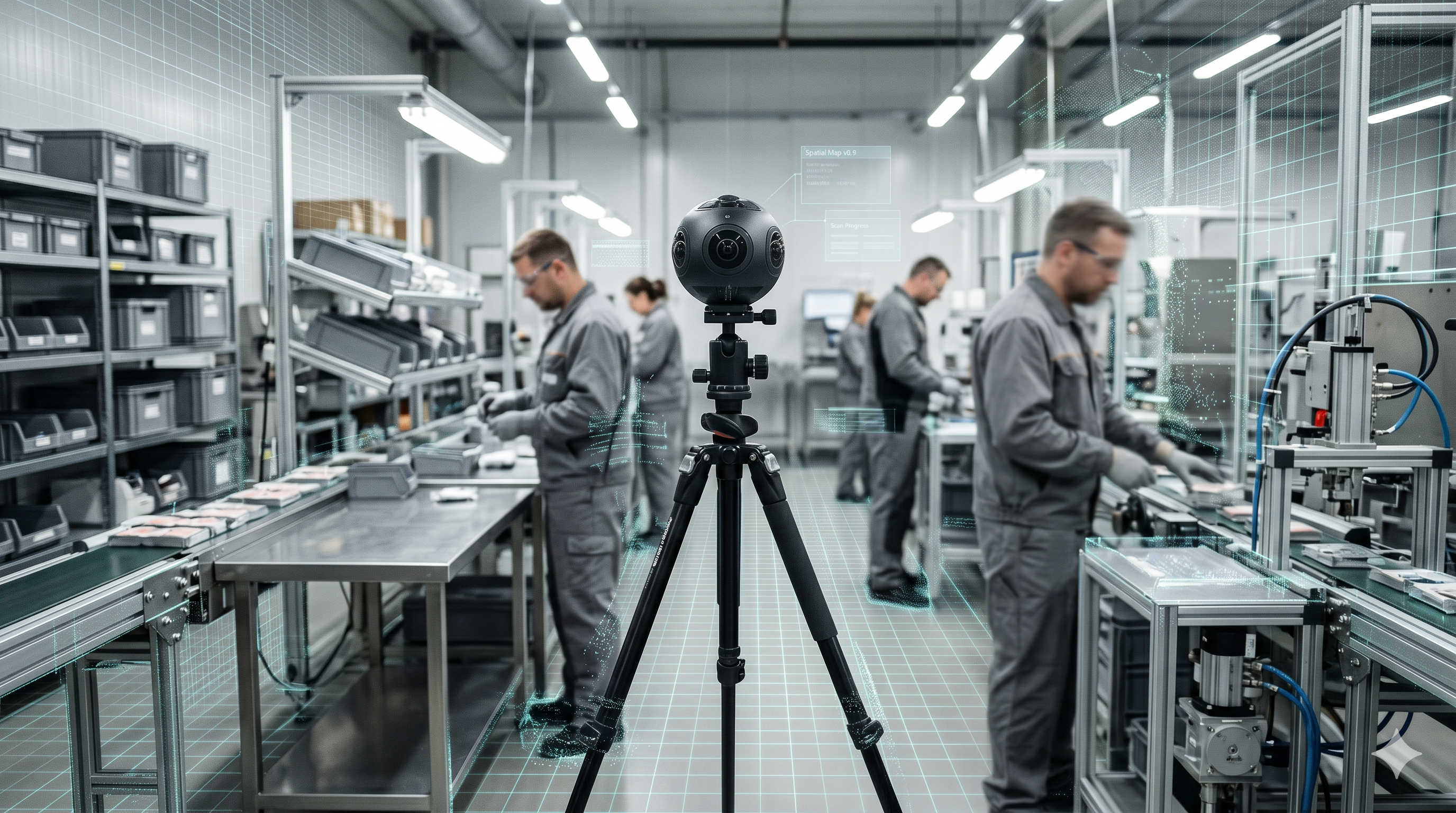
360-degree capture, 3D reconstruction, and factory simulation are no longer limited to global automotive plants. For many small and mid-sized manufacturers, the first step can begin with one practical question: where is the workflow actually slowing down?

In many small factories, the problem is not a lack of effort. Workers know the floor better than anyone. Managers know which line feels crowded, which corner creates waiting time, and which route keeps forklifts moving too close to people. The difficulty is that these problems are usually discussed through memory, experience, and rough sketches.
That is why digital twin technology is starting to matter for smaller manufacturing sites. Not as a large corporate showcase, and not as a full-scale autonomous factory project from day one. The more practical use case is simpler. Capture the real site, rebuild it as a digital space, simulate the current workflow, and compare layout changes before spending money on physical modification.
For a small and mid-sized business, or SMB (Small and Medium-sized Business), this changes the starting point. Digital twin no longer has to begin with perfect CAD (Computer-Aided Design) drawings, BIM (Building Information Modeling) files, or a dedicated internal engineering team. It can begin with the actual factory as it exists today.
Why Digital Twin Used to Feel Too Big for Small Manufacturers
The public image of digital twin has been shaped by large global factories. Automotive plants, semiconductor fabs, logistics hubs, and energy infrastructure sites often appear in the headlines. These projects usually involve long implementation periods, large system integrators, and deep connection with ERP (Enterprise Resource Planning), MES (Manufacturing Execution System), robotics, and automation systems.
That model is powerful, but it is not the first model most small factories can adopt.
A typical food processing site, metal parts workshop, warehouse, or light assembly plant often has a different reality. The drawing may be outdated. Machines may have been moved several times. Temporary storage zones may have become permanent. A new inspection table may have been added after a customer audit. The real site and the old drawing no longer match.
In this environment, asking a factory owner to prepare clean CAD or BIM data before even starting a digital twin project creates friction. The factory does not need another abstract system diagram. It needs a way to read the current floor as it is.

The Capture Layer Is Changing the Market
The key shift is the capture layer. With 360-degree cameras, LiDAR (Light Detection and Ranging), and 3DGS (3D Gaussian Splatting), a physical workplace can be reconstructed much faster than traditional manual modeling workflows.
3DGS (3D Gaussian Splatting) is especially important because it allows a real space to be reconstructed from image-based data into a navigable 3D scene. For factory use, this is not just about creating a visually attractive model. It gives managers a realistic spatial base for reviewing movement, equipment location, visibility, access, and possible layout changes.
SLAM (Simultaneous Localization and Mapping) and LiDAR-based scanning improve the spatial reliability of the captured environment. When these technologies are combined with simulation logic, the digital twin becomes more than a virtual tour. It becomes a working layer for operational decision-making.
This is where the opportunity for smaller manufacturers becomes clearer. They do not need to wait until every system is fully connected. A first digital twin project can focus on one bottleneck, one workflow, one line, or one warehouse zone.
A Digital Twin Should Not Stop at Visualization
There is a common misunderstanding in the market. Many people still think a digital twin means showing a factory in 3D. That is only the surface layer.
The practical value appears when the model is used for simulation. A factory manager can test worker movement, forklift routes, AGV (Automated Guided Vehicle) routes, AMR (Autonomous Mobile Robot) circulation, storage location, inspection flow, and equipment placement inside the digital space.
Instead of asking whether a new layout “looks better,” the team can ask better questions. How much walking distance can be reduced? Where does congestion happen? What happens if one AGV is introduced? Does the new route create a safety risk near a manual work zone? Which layout creates the lowest movement overlap between people and equipment?
Those questions lead to KPI (Key Performance Indicator) analysis. In a practical RX project, the core indicators usually include work time, walking distance, route overlap, bottleneck frequency, throughput, safety exposure, implementation cost, and ROI (Return on Investment).

The Market Signal Is Getting Stronger
Recent manufacturing technology news shows that digital twin, physical AI, robotics, and autonomous factory simulation are becoming standard topics in industrial transformation. In Korea, major events such as Autonomous Manufacturing AI World Show and SIMTOS 2026 placed digital twin and physical AI at the center of the manufacturing conversation.
There is also a competitive signal. Companies are beginning to combine LiDAR and 3DGS for industrial DX (Digital Transformation) and digital twin applications. Some players are moving into Southeast Asia, while software-based digital twin companies are strengthening AI (Artificial Intelligence) process simulation features.
This matters because the market is moving from “Can we scan a space?” to “Can we use the scanned space to make a better operational decision?” The second question is where small manufacturers need a more practical service model.
For Platzlab RX, the position is clear. The service should not be sold as a 3D model. It should be sold as a decision-support package for factory layout, logistics flow, AGV planning, safety review, and workflow optimization.
What a Practical RX Project Looks Like
A small factory digital twin project does not need to begin with a massive transformation plan. The first project should be narrow enough to produce a decision.
For example, a food processing company may want to know whether the packaging line should be moved closer to cold storage. A warehouse operator may want to test AGV routes before purchasing equipment. A metal parts manufacturer may want to reduce unnecessary walking between cutting, inspection, and packing areas. A bio-related facility may want to separate worker movement and material movement more clearly.
The RX workflow can be structured in a simple sequence.
| Stage | Purpose | Output |
|---|---|---|
| Site diagnosis | Define the operational question | Target zone and simulation scope |
| 360-degree capture | Record the real facility as it exists | Spatial capture data |
| Digital twin reconstruction | Build a usable virtual site | Navigable 3D factory model |
| Simulation scenario | Test current and alternative layouts | Workflow and route comparison |
| Decision report | Support management approval | KPI, ROI, and action plan |
The final report is important. Factory owners and executives are not buying a simulation video. They are buying a clearer decision. The deliverable should answer what should change, why it should change, how much impact it may create, and which step should be taken first.

When a Small Factory Should Start
The best starting point is not “We want to become a smart factory.” That is too broad for a first project.
A better starting point is a clear operational question. Is the current worker route too long? Is the packing area creating a bottleneck? Should we introduce AGV or AMR equipment? Can we add one more line without creating safety risks? Can we reduce movement overlap between forklifts and workers?
When the question is specific, the simulation can produce a decision. When the question is vague, the digital twin becomes a presentation asset rather than an operational tool.
For many small and mid-sized facilities, the strongest first use cases are food processing, warehouse and logistics, metal processing, precision machinery, and bio-related production environments. These industries usually have visible movement patterns, equipment placement issues, and layout decisions that directly affect productivity.
One Capture Can Serve More Than One Purpose
Another reason small factories should consider this approach is that the captured space can be reused. A 360-degree digital record of the facility can support safety training, onboarding, maintenance review, facility introduction, insurance documentation, and future layout planning.
This changes the investment logic. The digital twin is not a one-time visual asset. It becomes a spatial data layer that the company can continue to use as the factory changes.
For overseas manufacturers looking at Korea’s industrial technology market, this is also an important signal. The next phase of digital twin adoption will not only belong to large companies with fully integrated automation systems. A meaningful part of the market will come from smaller facilities that need faster, lighter, and more decision-oriented tools.
Platzlab RX Perspective
Platzlab RX focuses on digital twin projects for small and mid-sized manufacturing facilities, warehouses, and operational spaces. The approach combines real-site capture, spatial reconstruction, simulation scenario planning, and decision reporting.
The key is not to make the factory look digital. The key is to help the management team see what decision should be made before they move equipment, purchase automation hardware, or redesign the workflow.
If a factory does not have accurate drawings, that is not a reason to delay the first step. In many cases, the current site itself is the best starting point.
Project Inquiry
Platzlab RX works with manufacturers, warehouse operators, automation partners, and public-sector innovation programs that need practical digital twin simulation for real operational decisions.
Email: contact@platzlab.com
Source note: This article is based on Platzlab RX internal research dated May 7, 2026, including market observations on manufacturing digital twin, physical AI, LiDAR, 3DGS, and factory simulation trends. External references mentioned in the internal research include SIMTOS 2026, Autonomous Manufacturing AI World Show, Siemens digital twin case material, Statistics Korea manufacturing data, and Korea smart manufacturing support program information.

댓글 남기기